

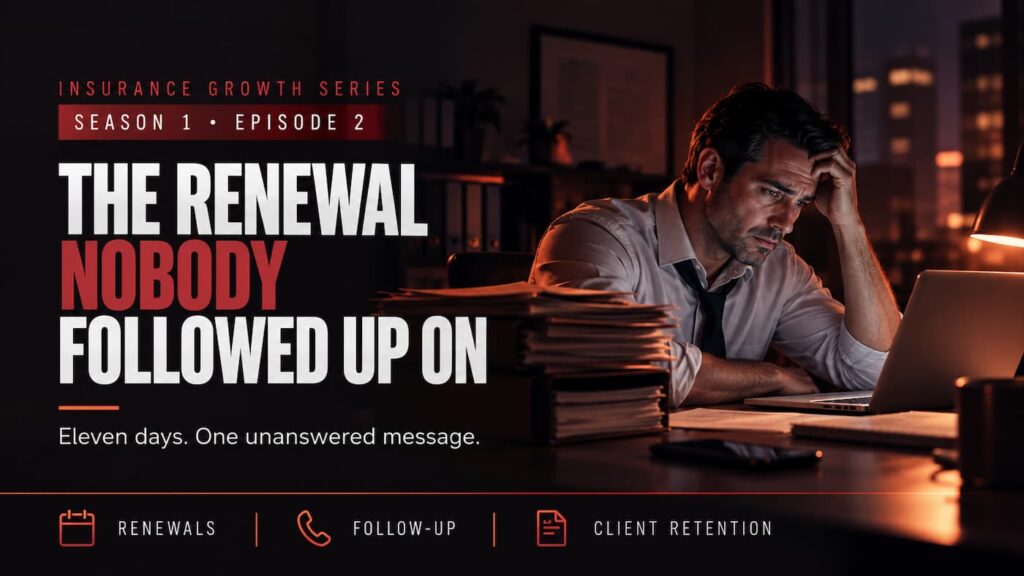
DC HELPERS ORIGINAL · INSURANCE GROWTH SERIES · SEASON 1, EPISODE 2
Previously, in Episode 1, Marcus spent a full Monday on certificates, quotes and endorsements, and left a renewal question from Ellen, a client of nine years, for later. By Tuesday morning she had already talked to another agent. He hung up and picked up the phone again.
In this episode, Marcus looks at his renewals for the first time in months and learns how insurance renewal follow up really breaks down. It is rarely one big mistake. It is a message nobody answered.
Tuesday, 9:12 a.m.
Michael answered on the second ring. “Marcus. Thanks for calling back.”
“Sorry it took a day. Tell me about Maple Street.”
Michael explained. A buyer named Sarah, serious and pre-approved. Her lender had mentioned the area, and she wanted to know what insuring the house would look like before she went any further. “She asked me on Sunday,” Michael said. Then, after a pause, “I didn’t answer her until Monday night.”
Marcus knew that pause. He had made the same one with Ellen the day before.
He promised Michael a rough quote by the end of the day. This time he wrote it at the top of his list instead of somewhere underneath it.
The list he never kept
After the call, Marcus did something he had been putting off for months. He pulled up every renewal coming due in the next sixty days.
There was no single place to look. Some dates lived in the agency management system, some in a spreadsheet he had last updated in the spring, and some only in his head. It took him almost an hour just to build the list.
Fourteen renewals. He went through them one by one and asked a simple question about each one. When did anyone last talk to this client?
For most of them, the honest answer was last year.

Eleven days
Halfway down the list he reached Renee, who runs a small flower shop two streets from his office. Her shop and her home were both insured with Marcus, and both renewed on December 1.
Something about her name bothered him. He picked up his phone and scrolled back through his texts until he found it.
“Hi Marcus! My renewal notice came in and the price went up again. Can we look at options before it renews? No rush, whenever you have a minute.”
Eleven days ago.
He remembered reading it. He remembered planning to call her that afternoon, after the certificate, after the carrier, after whatever else was on fire that day. Then the message had simply slid down the screen, under newer and louder ones, until it disappeared.
Nobody had decided to ignore Renee. That was the uncomfortable part. Nobody had decided anything at all.
Tuesday, 11:40 a.m.
Marcus replied right away. “Renee, I’m so sorry for the delay. I’m pulling your options together now. Can I call you tomorrow morning?”
Then the rest of the day did what his days always did. A client needed proof of insurance for a new lease. A carrier changed a form. The quote for Sarah took longer than it should have because the property details had to be requested twice.
Renee didn’t answer.
Tuesday, 8:47 p.m.
Her reply came in while Marcus was clearing the kitchen table.
“No worries, Marcus. Honestly, I figured you were busy. I’ve been meaning to ask around anyway. Talk tomorrow!”
It was a friendly message. It was also the most worrying one he had received all week. “I figured you were busy” meant she had already made peace with waiting. “Ask around” meant she had started looking.
Ellen had left after one day. Renee had waited eleven. Marcus understood that the difference between the two was luck, and luck is not a system.

How renewals really get lost
Renewals rarely disappear because of one big mistake. They slip away in the space between “I’ll call tomorrow” and tomorrow. If you run an agency, these are the warning signs Marcus found in his own week.
The stakes are higher than most producers assume. Industry data cited by Insurance Thought Leadership puts retention for clients with a single policy at roughly 77 percent. That means almost one in four of those clients walks away every year, often without saying a word.
- Renewal dates live in more than one place. A system, a spreadsheet and someone’s memory never agree for long.
- Nobody owns the follow-up. When anyone can call the client, it usually means no one does.
- Client questions arrive through personal channels. Texts and direct emails are easy to read and easy to lose.
- The first conversation happens after the notice. By the time a client sees a higher premium, they are already comparing.
A simple renewal rhythm solves most of it. Review the policy around 60 days out, reach the client before the notice lands, present options with time to decide, and confirm before the renewal date. Knowing the steps is easy. Protecting the time to do them every single week is the hard part. That steady, repeatable work is what our virtual assistant services are built to take off a producer’s desk, and we explain why that time disappears in the first place in our guide on what insurance producers should delegate.
Up next. Marcus promises Renee real options by Friday, but the carriers are in no hurry, and another producer has just sent her a friendly message. Episode 3, The Waiting Game, premieres Wednesday, October 21. While you wait, see where Sarah’s question started in the Realtor Growth Series, Episode 2.
THE ASSISTANT MARCUS NEEDED THIS WEEK
A Renewal and Retention Assistant
Renewal dates lived in three places, and Renee’s message sat for eleven days. Nobody decided to ignore her. Nobody owned the follow up.
What they take off your plate
- Building and updating one renewal list every week
- Reaching clients about 60 days before renewal with a personal check in
- Requesting remarket quotes and preparing options for your review
- Tracking every reply so no message slides down the screen
What you get back. Clients hear from you before the price increase notice does.
The Time Check takes about 2 minutes and shows how many hours admin is costing you every week.
INSURANCE GROWTH SERIES · SEASON 1
You just finished Episode 2
UP NEXT · NOW AVAILABLE
KEEP READING



LET’S TALK
Let’s take renewal follow ups off your plate.
In a free 20-minute call we’ll look at what’s eating your week and show you exactly what a virtual assistant can take over, so you can decide with real numbers in front of you.


